


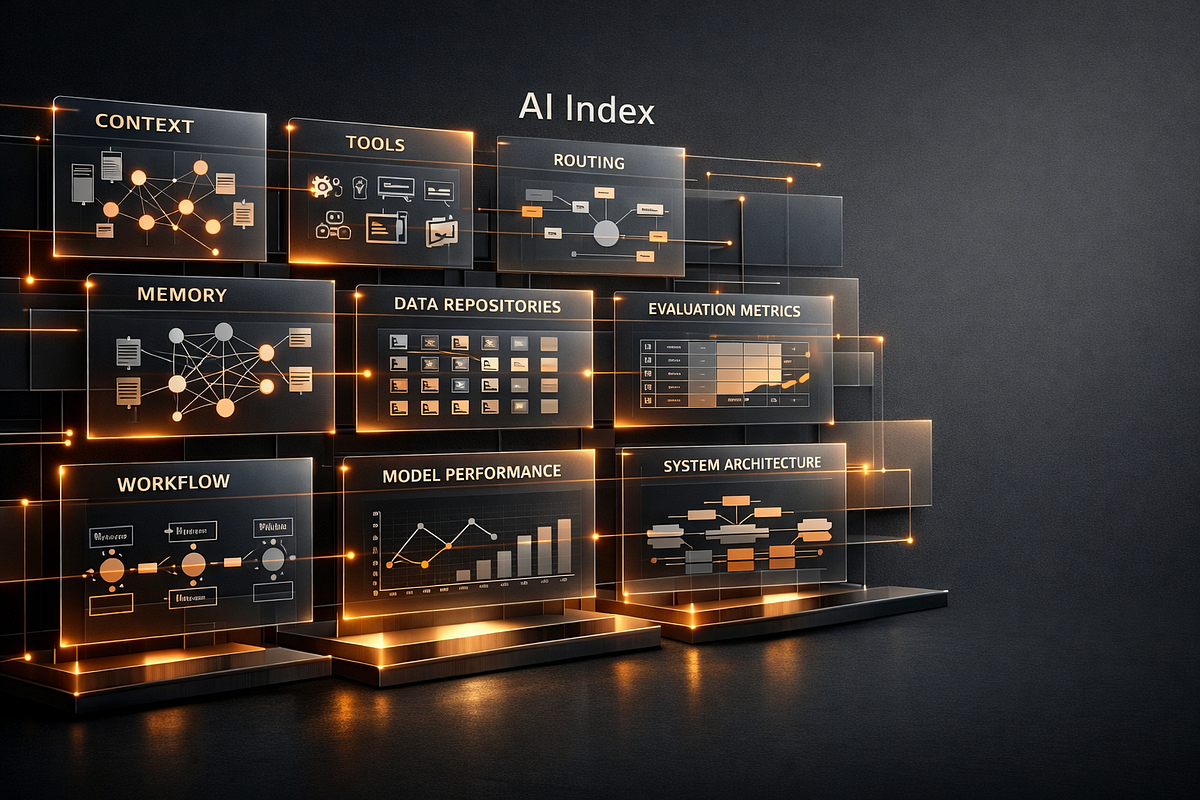
A growing index of my writing on practical AI use: coding tools, local models, context, evaluation, and the habits that make AI useful
What this is
Generative AI is already past the stage where the most useful questions are “what is an LLM?” or “give me better prompts.”
The practical questions are more interesting:
Which tools are actually worth learning?
What is the difference between an assistant and an agent?
When does local AI make sense, and when is it just extra friction?
How do you work with tools like Claude Code, Codex, Cursor, Copilot, Ollama, Cline, Gemini CLI, Aider, OpenCode, and similar systems without turning your workflow into chaos?
How do you keep control of your codebase, your data, your time, and your judgment?
That is what this collection is for. And this is where I gather my writing on practical AI for technical people: software engineers, architects, sysadmins, DevOps practitioners, and intermediate users who want a clearer mental model of this fast-moving space.
I’m not especially interested in AI as spectacle. Instead, I’m interested in AI as a tool: useful, messy, expensive, impressive, sloppy, productive, and sometimes genuinely transformative. Usually not all in the same way, and never without tradeoffs.
So the writing here leans toward workflow, boundaries, verification, context, tooling, and engineering judgment rather than hype.
Who this is for
This collection is mainly for people who are already technical, even if they are still early in AI.
You do not need to be an ML engineer. But it helps if you already think in terms of repos, terminals, APIs, tests, systems, and tradeoffs.
So this is less “AI for absolute beginners” and more AI for people who want to use it seriously without getting lost in noise.
Stories index
Foundations and mental models
(assistants vs agents, IDE tools vs terminal tools vs cloud workers, what “agentic coding” really means, and how modern AI workflows are actually structured)
- Stop calling everything “AI”: A practical map of assistants, agents, IDE copilots, CLIs
The practical differences between chatbots, coding assistants, agents, IDE tools, terminal tools, and cloud workers - Prompting is not enough anymore
Model, harness, tools, memory, rules, and execution environment — what actually shapes the result - The real AI workflow stack: Model, harness, tools, memory, rules, and execution
Model, harness, tools, memory, rules, and execution environment — what actually shapes the result - Cloud agent vs local agent vs IDE assistant: What each setup is actually good at
How to choose the right execution model for privacy, speed, review, and real work - What “agentic coding” really means: Useful autonomy, bounded execution, and real control
“Agentic” became a buzzword so fast that many people now use it to describe any tool that writes code for longer than ten seconds - How to choose your first AI coding tool
A beginner-safe way to pick the right setup without drowning in hype and comparison posts
Context, rules, and durable project guidance
(persistent project guidance, architecture notes, skills, memory, and documentation for agents)
- Context engineering for developers: Why your project needs instructions that survive the next prompt
Why persistent project context now matters more than repeating yourself in every new session - CLAUDE.md, AGENTS.md, Cursor rules, and skills: Which layer should hold what
The hard part is rarely writing instructions. The hard part is deciding which instructions deserve to live where. - How to write rule files that actually help instead of polluting every session
Turning vague preferences into concrete, scoped instructions an AI agent can really follow - Docs for humans vs docs for AI agents
Why architecture notes, onboarding docs, and AI instructions should overlap , but not be the same thing - Coming soon: Reusable agent skills
- Coming soon: How to teach an agent your architecture
Tooling and workflow guides
(articles on tools like Claude Code, Codex, Cursor, Copilot, Cline, Gemini CLI, Aider, OpenCode, Ollama, and related systems)
- Coming soon: Claude Code for normal teams
- Coming soon: Codex in 2026
- Coming soon: Cursor after the hype
- Coming soon: GitHub Copilot beyond autocomplete
- Coming soon: Terminal-first AI coding
- Coming soon: Which AI coding tool should a beginner start with today?
Control, evaluation, and safer use
(bounded tasks, visible diffs, tests, review, benchmarking, and how not to fool yourself)
- Coming soon: How to use coding agents without surrendering your repo
- Coming soon: Give the agent better truth
- Coming soon: MCP without the buzzwords
- Coming soon: How to benchmark an AI coding workflow without fooling yourself
- Coming soon: AI for large codebases
Local, open, and self-hosted AI
(when local models are good enough, where they are not, and what it really costs to run your own stack)
- Coming soon: When local models are good enough
- Coming soon: Why OpenAI-compatible endpoints matter so much
- Coming soon: Open models for coding work
- Coming soon: Open-source agents for privacy-minded teams
Team practice and maturity
(shared standards, repository rules, AI-assisted PR workflows, and what more mature AI development may look like)
- Coming soon: Single-agent vs multi-agent workflows
- Coming soon: From AI assistant to AI teammate
- Coming soon: What mature AI development probably looks like next
Commentary
(my personal thoughts on topics related to AI and its development)
- The web after search: What happens when AI answers become the front page
Google, OpenAI, Perplexity, and others are turning search from a list of links into an answer layer. That changes SEO, publishing, attribution, and the economics of the open web. - The assistant that remembers too much: Personal AI agents after the chatbot era
The next AI interface is not a blank chat window. It is an always-available system with memory, tools, permissions, and access to your private context. - The end of unlimited AI coding. Why agentic development is becoming a cost-control problem
Flat-rate subscriptions made AI coding feel cheap. Multi-agent workflows, long-context planning, testing loops, and usage-based pricing are forcing teams to ask a harder question: how much should one coding task be allowed to cost?
Final note
AI is becoming part of normal technical work. That means the useful questions are getting less theatrical and more concrete:
How do we set this up well?
How do we keep it legible?
How do we review it?
How do we bound it?
How do we make it worth the cost and attention it consumes?
That is the territory I want to cover here.
If this sounds like your kind of AI writing, bookmark this page. I’ll keep expanding it as new pieces are published.
To Top